1837-1908
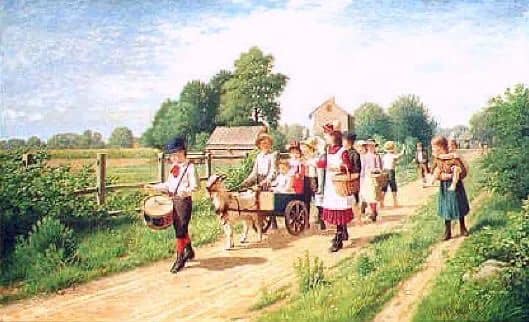
Mr. Carrs Pastoral Goat Carts
Samuel S. Carr was a prolific pastoral genre painter who lived from 1837 – 1908. Although born in England, he lived most of his life in NY, with his sister and brother-in-law, working as a career painter. He was heavily inspired by the rural landscapes, quiet suburbs, and seaside vacation spots of the northeastern United States, and his work includes quite a few goat carts, several examples of which are on the right, and below. If you look closely, you can see a certain goat making multiple appearances


1847-1860
Queen Victoria’s Royal Family Goat Carriage
A print, showing the children of Queen Victoria, promenading their ermine decked goat carriage through Windsor Park.

1888-1962
Overland Jack
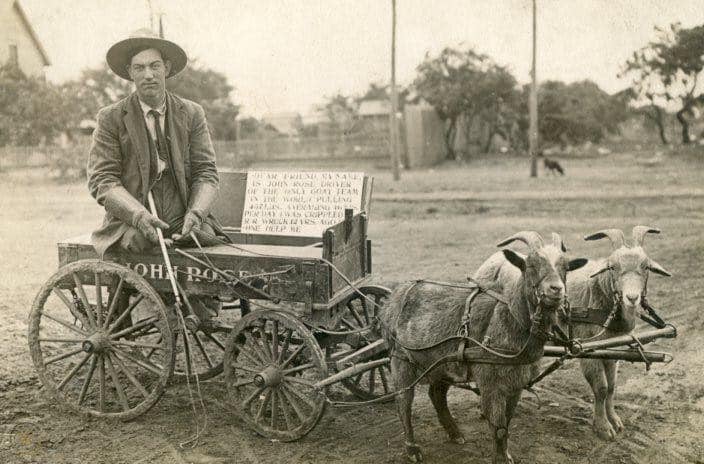
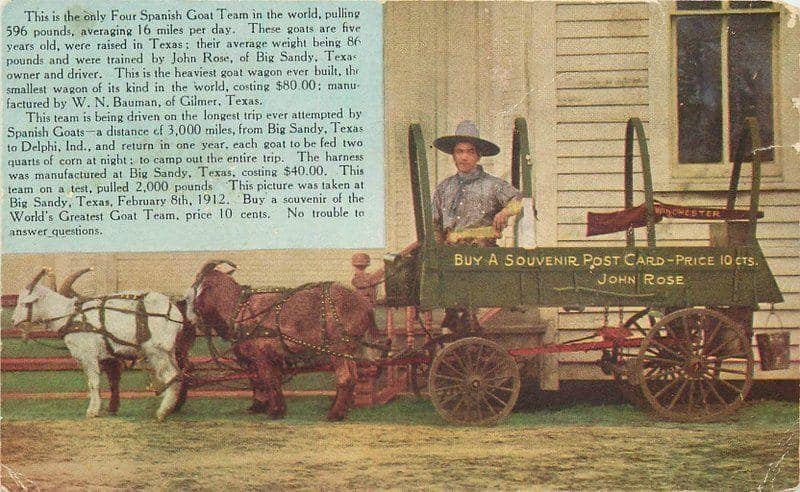
John Rose, known as Overland Jack, was a teamster, watch and gun repairman, and double amputee, who logged over 30,000 miles in his compact covered wagon, pulled by hitches of rugged Spanish goats. Below, is an article about him, from texashighways.com , called The Goat Man of Big Sandy, written by Gay Ingram, of Big Sandy, Texas:
“A large tombstone—with a goat’s head carved to the right and a revolver to the left—marks the resting place of John “Overland Jack” Rose in Chilton Cemetery in Big Sandy. Centered above his name, a small oval holds a picture of John, his wagon, and his goat team.
John, born in Virginia in 1888, fell beneath the wheels of a freight train and lost both of his legs at age nine. By means of hand-walking props that he made himself, he was able to remain ambulatory and complete his education. At age 20, he began traveling the country, driving a small wagon drawn by goats. He eventually settled in Big Sandy, built a home beside Everman Lake, and, refusing public aid or charity, supported himself and his goats by doing small repair jobs on watches, eyeglasses, guns, and antique clocks. Each year in early spring, “The Goat Man,” as townspeople affectionately called him, would set out from Big Sandy, making about 10 miles a day, stopping to sell postcards of himself for a dime, and doing repair work whenever he could find it. By the time automobiles made the roads too dangerous and ended his travels, he had toured 19 states and covered some 30,000 miles. Overland Jack died in 1962. His personal property was auctioned, and his goat cart donated to Tyler’s Caldwell Zoo. One of his postcards is in the archives of the Historic Upshur Museum (903/843-5483) in Gilmer.”


1889-1893
President Harrison’s Family Goat Cart
An 1891 photograph of President Benjamin Harrison with his grandchildren, and his goat “Old Whiskers” (a.k.a. “His Whiskers”). From left to right: Marthena Harrison, Russell Benjamin Harrison, Old Whiskers, Benjamin “Baby” McKee, and Mary McKee. In the front is Dash, the family dog.
On the lower right is a clipping from a 1903 issue of the Washington Evening Star, with a fun anecdote about President Harrison and Old Whiskers.


1895-1918
The Tsar’s Daughters’ Royal Goat Team
Grand Duchess Tatiana Romanov, and her older sister, the Grand Duchess Olga Romanov, in their beautiful goat cart with a tasseled harness, possibly at the Catherine Palace in Tsarskoye Selo

1898
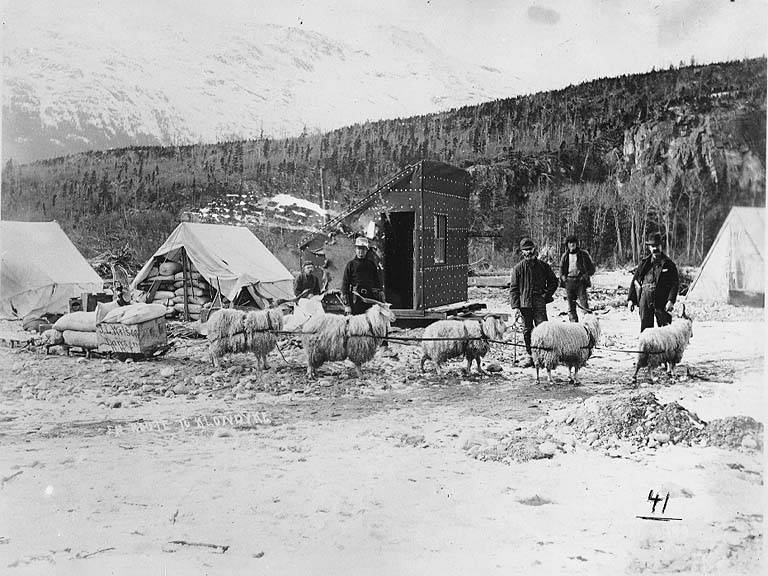
Goat Sleds in the Klondike
Teams of Angora goats helped bring supplies to remote locations, during the Alaska gold rush. With their sure feet and thick mohair coats, these draft goats were right at home, in the rugged terrain around the Klondike.
The image below is captioned “En route to Klondyke.” It was photographed in the spring of 1898, by Eric A. Hegg, near Skagway, Alaska. The photographers of the pictures on the right are unknown, but they may have been taken by Hegg as well. They are all dated from 1898. The upper right hand picture is captioned “Goat train leaving Dyea, Alaska, 1898, on the way to Sheep Camp and then on to Dawson City” on its reverse side.


 AWSGA
AWSGA 